
Hiking with Children: The Complete UK Family Guide for 2026
Ready to go hiking with children? Discover UK family walk tips, age-by-age hiking guides, essential gear picks, and the best trails for all ages.
Last Updated on 29 June 2026
Disclosure: Some of the links on this site are affiliate links, which means I may earn a small commission if you click through and make a purchase. This comes at no additional cost to you. Read my affiliate disclosure to find out more.
If you’ve ever wondered whether hiking with kids is worth it, I’m here to tell you: it is, but only if you’re prepared. When I first started hiking with children, I had no idea how much thought goes into a successful day out on the trails. Would my toddler make it past the first hill? Would my eldest one moan the whole way? (Spoiler: sometimes yes to both, and we still had a great time.)
Over the years, I’ve gone from the nervous first-timer to someone who loves planning family hikes across the UK, from the rolling hills of Exmoor to the wilder trails of Snowdonia. Family outdoor activities like hiking have become the backbone of how we spend our weekends, and the benefits are amazing for my girls.
According to a report from the Raising the Nation Play Commission, the amount of time children spend outside has declined by 50% in a generation. I was shocked by that statistic when I first read it, and it’s a huge part of why I believe family walks and outdoor adventures matter more than ever.
In this guide, I’ve pulled together everything I wish I’d known from the start: the best hiking trails for families in the UK, what gear you need, how far can children hike by age, and how to keep everyone, even the most reluctant little legs, engaged.
Let’s read on to find out more!
Read more: The Best Hiking Gear for Kids of All Ages in 2026
What Age Can Children Go Hiking?
One of the most common questions I get asked is: What age can children go hiking? Everyone is different, but for us, we’ve taken ours from when they could hold their head up without support or they were in a front sling. However, when people decide will look very different at each stage of childhood.
- Babies (0–12 months): You’re doing the walking for them. A good baby hiking carrier (when they can hold their head up by themselves) or baby sling will let you hit the trails comfortably while keeping your little one close and safe. Short, flat family walks are ideal at this stage, around two to four miles maximum, based on your energy levels.
- Toddlers (1–3 years): This is where hiking with kids starts to get interesting. Toddlers can walk short distances, but will tire quickly and without much warning. When ours were small we would use a combination approach. For instance, let them walk part of the way, then pop them in a carrier when the terrain got tricky or they got tired.
- Preschoolers (3–5 years): These little ones can manage more ground and love discovering things: bugs, sticks, puddles, unusual-shaped rocks. Keep it to two to four miles with plenty of stops for exploring, and you’ll be amazed how much they can cover.
- Primary school age (5–11 years): This is where family hikes come into their own as an adventure. Children this age can manage five to eight miles on gentler terrain and begin to enjoy the landscape around them. My eldest is nearly seven and she’ll quite happily walk for miles when we’re out exploring.
- Tweens and teens (11+): With the right gear and enough snacks, older children can take on serious hiking challenges, even multi-day routes or sections of longer-distance paths.
For more detail on hiking with very young children, have a read of my guide to hiking with toddlers. It covers everything from nap times on the trail to the best toddler footwear.
Safety note: Always consult your GP or health visitor before hiking with babies under six months, particularly in hot or cold weather. This advice is general as every child is different.
How Far Can Children Hike by Age?
Understanding how far can children hike by age is the single most important thing you can get right before hiking with children.
I once planned a six mile route when my eldest was three. Unsurprisingly, we didn’t complete the walk because my daughter wanted to stop and look at everything along the way.
Here’s a practical, experience-based guide to realistic distances for hiking with kids at different ages:
| Child’s Age | Realistic Daily Distance | Terrain |
| Baby (in carrier) | 5-10 miles (adult’s limit) | Any |
| 2-3 Years | 1-2 miles | Flat, smooth paths |
| 3-5 Years | 2-4 miles | Gentle, well-maintained trails |
| 5-7 Years | 3-5 miles | Moderate with rest stops |
| 7-10 Years | 5-8 miles | Varied terrain |
| 10-12 Years | 6-10 miles | Most terrain |
| 12+ Years | 8-15+ miles | Most terrain with the correct prep |
My rule of thumb for our family walks: I plan for roughly one mile per year of age as a comfortable starting point. So my 6-year-old can comfortably manage around six miles on a good day. I always factor in elevation as well. A hilly 3-mile route will feel like twice the distance to small legs while the return journey always feels longer to a tired child than the outward one.
Read more: Hiking with a Two-Year-Old: What You Need to Know in 2026
Choosing the Right Trail When Hiking with Children
Start with a Circular Route
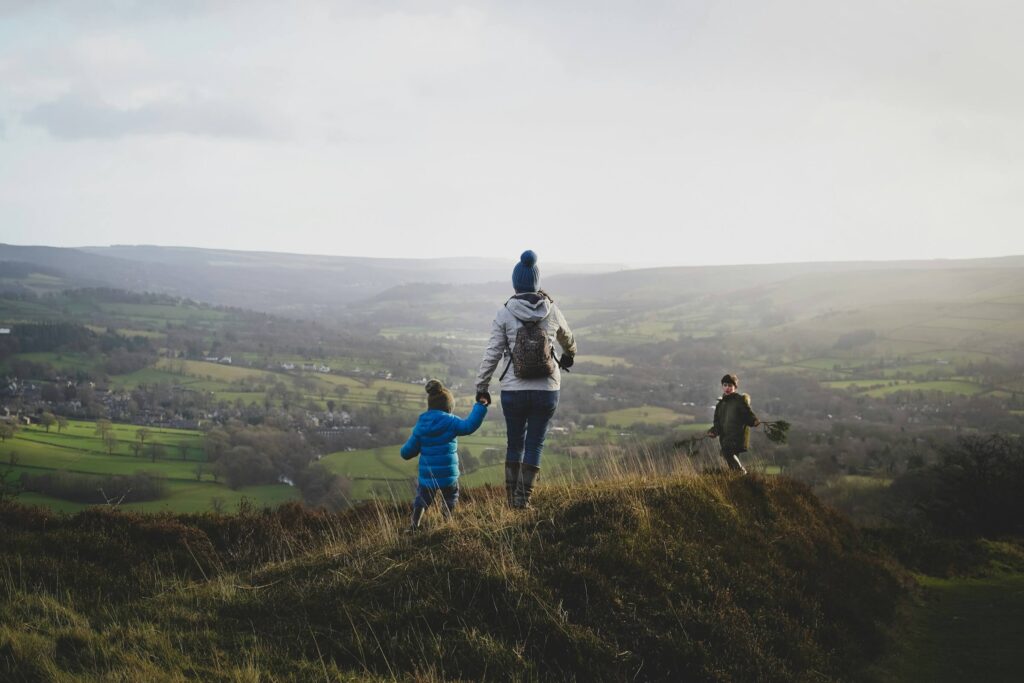
I always favour a circular walk because nobody has to retrace the same path. Circular family hikes are widely available across all UK National Parks and on OS Maps, which is my go-to planning tool.
Look for Wow Moments
Children, mine included, stay motivated when there’s something to aim for, such as a waterfall, a viewpoint, a castle ruin, a beach at the end, wild ponies in a field. I always build our family hikes around at least one destination that the children can look forward to throughout the walk.
Consider Facilities
For family outdoor activities like hiking with children, knowing there’s a café, a toilet, or a car park at the end makes everyone’s day considerably easier.
Recommended UK walking resources:
- OS Maps: detailed route planning with difficulty filters
- National Parks UK: family route suggestions in every park
- Komoot: free app with excellent family hikes filter
- AllTrails: Plenty of good UK coverage for family walks
Essential Gear for Hiking with Children
Getting the right kit transforms a family hike. I’ve learnt this the hard way: soggy socks have ended more than one walk in our house, and an ill-fitting carrier left me with a sore back for a week.
Children’s Walking Boots
The correct footwear is the most important piece of kit for hiking with children, even on short family walks. Children’s walking boots protect young feet on uneven terrain and keep them dry on the wet, muddy paths that are unavoidable in the UK.
What to look for in children’s walking boots:
- Waterproofing: GORE-TEX or an equivalent membrane
- Ankle support, particularly important on rocky or uneven terrain
- Grippy outsole (Vibram is the gold standard for trail footwear)
- A good fit with a little wiggle room for thick walking socks, not too loose or too tight
My top picks for children’s walking boots: we’ve used the Oscar Kids Walking Boots from Mountain Warehouse for years and have never had any complaints. They’re breathable, stable, and for those long adventure trips, they provided much needed comfort.
Waterproof Jacket for Kids
British weather being what it is, a good waterproof jacket when hiking with children is something all parents should have on hand, even in summer. Look for fully taped seams (not just water-resistant coating, which wears off), a hood that stays up in the wind, and enough length to cover their back when they’re wearing a rucksack.
Mountain Warehouse, Regatta Kids, and Patagonia all make excellent options at different price points. I love Mountain Warehouse (and they always have a sale going on) for my girls, and have yet to have any complaints about their products when our adventures take a wet turn.
Toddler Hiking Carrier
If you’re going on family hikes with children under three, a toddler hiking carrier is a complete game-changer. We’ve used the Osprey Poco toddler hiking carrier with our eldest and now with our youngest who is three. Considering we’ve used it for years with no complaints, I’d say it’s worth every penny.
Key features to look for:
- A padded hip belt to transfer weight off your shoulders
- Adjustable seat height as the child grows
- UPF sun canopy for summer family walks
- A dedicated storage compartment for nappies, snacks, and a spare layer
For a full breakdown of all the kit I recommend, see my dedicated guide: The Best Hiking Gear for Kids of All Ages.
What to Pack When You’re Hiking with Children
Download my FREE Day Hiking Packing List for Kids, which gives you all the kit you need for your next successful adventure with your children.
Read more: The Best Hiking Snacks for Kids: 82 Tasty Ideas to Try in 2026
Hiking with Children Safety
Hiking safety for families is always my top priority when planning any route. Here is what I do each time:
Tell Someone Your Plans
Before we do any hiking with children, we always inform someone about our planned route and our expected return time. This is especially important for family walks in more remote areas like the Scottish Highlands, Dartmoor, or the higher reaches of Snowdonia.
Check the Weather Forecast
I always check the Met Office Mountain Weather forecast before any upland hike. UK weather changes fast, particularly in the mountains, and conditions at altitude can be different from what it looks like in the valley car park.
Know Your Family’s Limits
Just because you can walk eight miles doesn’t mean your three-year-old will. It’s always better to turn around having completed some of a planned route than to push exhausted children, and yourself, beyond your comfortable limits. There will always be another day.
Sun and Heat Awareness
On warm days, even on relatively short family walks, sun exposure and dehydration can sneak up quickly on children. We always use sun cream with an SPF 50, even for us adults, at the start of any walk, making sure to reapply every two hours. We also carry more water than we think we’ll need.
Tick Awareness
Ticks are increasingly common across UK woodland and moorland, and something every parent should be aware of. After any walk through areas with long grass, bracken, or woodland undergrowth, do a thorough tick check on children and remove any attached ticks promptly with a tick removal tool.
Read more: When Can Babies Go Hiking? 21 Helpful Tips You Need in 2026
How to Keep Children Motivated on the Trail

Hiking games for kids are one of the most powerful tools in any family hiker’s arsenal. Here are our family’s firm favourites:
The Colour Hunt
Ask your children to spot as many different colours in nature as possible and list them as they go. This is a brilliant hiking game for kids at the toddler and preschool stage, and will keep them engaged as they find all the different colours.
I Spy (Trail Edition)
Instead of letters, use descriptive clues: “I spy something that looks like it has been placed by a giant” (a large boulder) or “I spy something that smells of summer” (wildflowers). A much more creative version of the classic and one of the best hiking games for kids of all ages. My girls love this version of I Spy when we’re outside exploring.
The Sound Map
Stop for five minutes and ask your children to close their eyes and listen. Then draw a circle on a piece of paper and mark where each sound is coming from: a nearby stream on the left, birds calling from above, wind through the trees ahead.
It’s a mindfulness-based hiking game for kids that will captivate them as they listen to the outside sounds. This is a good activity to do if you’re resting little legs.
Nature Bingo
Print or draw a simple bingo card before you leave home, with things to spot: a red berry, a feather, a rabbit, a stone wall, a footbridge, a cobweb. First to complete a line wins. Simple, effective, and costs nothing to prepare. We love using these nature scavenger hunts in spring and autumn.
Best Hiking Trails for Families in the UK
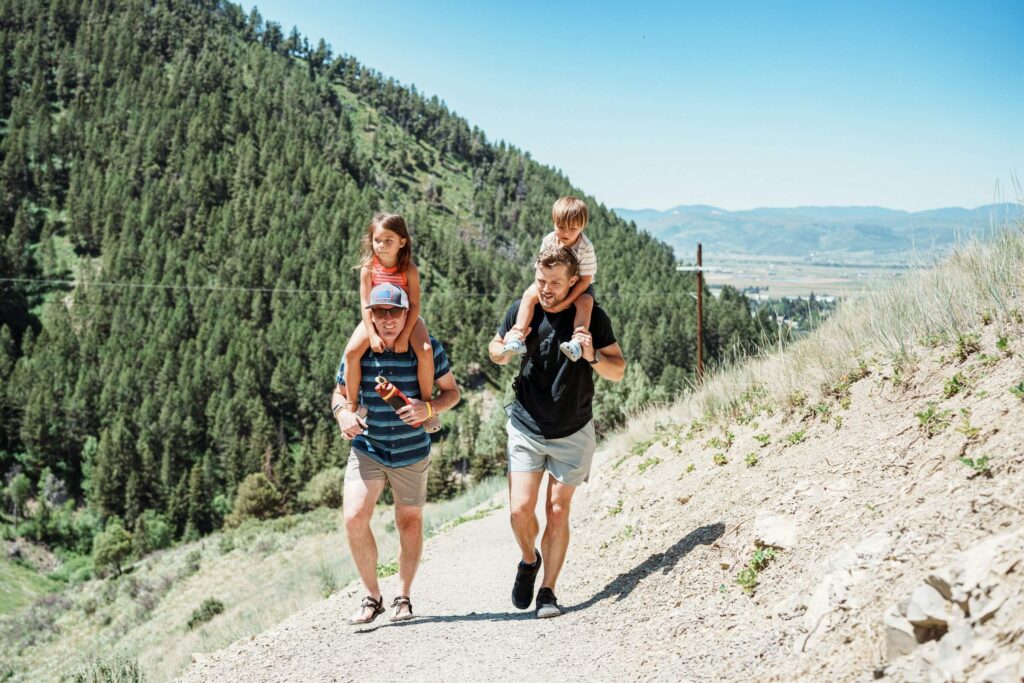
Here are some of the best hiking trails for families in the UK that I’ve walked with my own children:
Exmoor Walks with Children
Exmoor is where I did some of my first hikes before I had children. It’s always a pleasure taking them to Devon and exploring and enjoying the landscape.
The valleys around Watersmeet are spectacular, with a relatively easy riverside walk through ancient oak woodland that ends at a National Trust tea room.
The coastal path between Lynmouth and Heddon’s Mouth is another stunning spot that’s manageable for families with older children. Wherever you go, you’ll be spoilt as it’s just so beautiful.
The New Forest
Perfect for hiking with children whatever their age. Flat, well-marked trails, wild ponies ambling freely through the trees, and plenty of café stops along the way. The New Forest is one of the most accessible National Parks with toddlers and preschoolers, and it’s beautiful in every season.
Snowdonia Walks for Families
Snowdonia offers something for every age and ability level, which is what I love most about this part of North Wales.
For ambitious older children, the Watkin Path and Miner’s Track are popular routes heading towards Snowdon’s summit. For younger children or those new to hiking with children, the lower valleys around Betws-y-Coed are gorgeous, gentle, and manageable.
Lake District Family Walks
The Lake District is another firm favourite spot to visit. Tarn Hows is a must-do for any family, a flat, circular walk around a beautiful tarn that’s stunning at any time of year.
For older children who want something more rewarding, a gentle ascent to Loughrigg Fell offers panoramic views without the challenge of the major peaks.
Lake District family walks around Windermere, Coniston Water, and Buttermere also offer brilliant, well-marked routes at a range of difficulty levels.
Exploring the Brecon Beacons
Waterfall Country in the Brecon Beacons is brilliant for family outdoor activities and one of the most visually dramatic areas for family walks in Wales. The combination of ancient woodland, fast-flowing rivers, and cascading waterfalls makes it feel like an adventure story from the moment you step out of the car.
Loch Lomond & The Trossachs in Scotland
Our most ambitious family hike to date took us to Scotland, and it remains one of our best family holidays. Shorter sections of the West Highland Way, such as Balmaha to Rowardennan along the eastern shore of Loch Lomond, make perfect family hikes for a full day out. Here, you’ll find some of the most spectacular views anywhere in the UK.
Hiking with Toddlers: Special Considerations
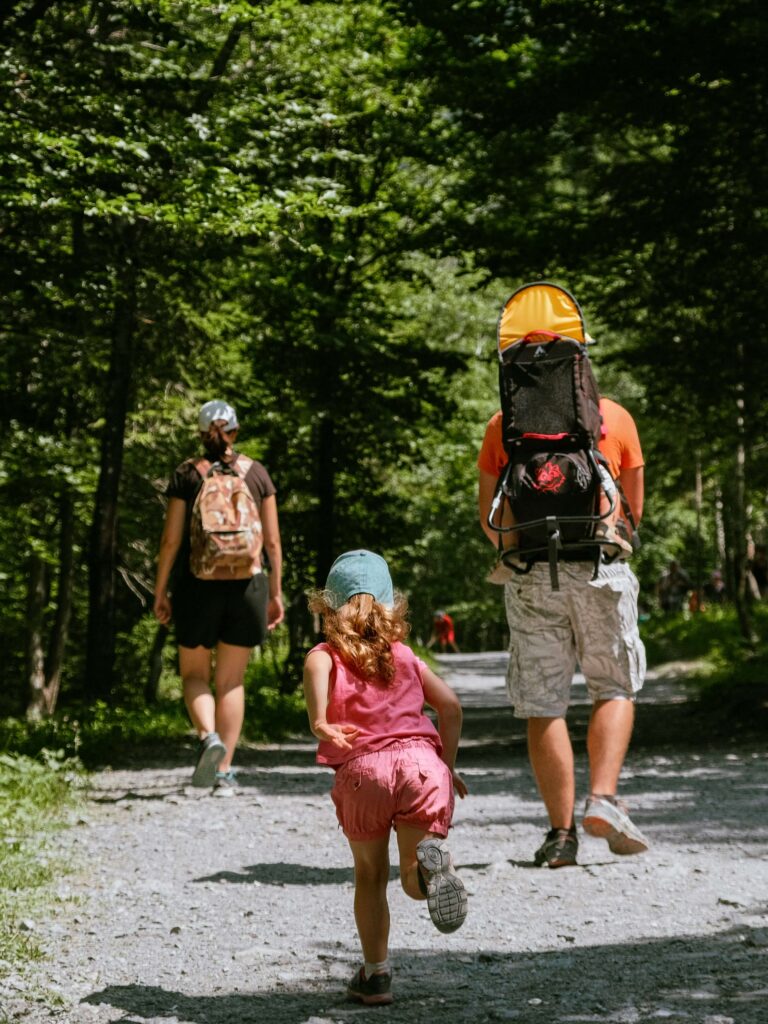
Toddlers deserve their own section when it comes to hiking with children, because they operate by their own rules on a trail; mine did anyway. I’ve covered this in much more detail in my full guide to hiking with toddlers, but here’s the essential overview for family walks with under-3s:
Manage Expectations (Yours, Not Theirs)
So important, and something I had to quickly learn when I took my eldest out for a walk. A two-year-old will stop to examine every interesting pebble, every puddle, every unusual stick, and every passing dog. This is not a problem, this is the entire point of family outdoor activities at this age. Plan your family hike accordingly and leave plenty of buffer time in the schedule.
Use a Toddler Hiking Carrier as Backup
Even if your toddler is a confident and enthusiastic walker, you will need a hiking carrier for when their energy runs out. In my experience, this moment arrives precisely on the steepest uphill section of the entire walk.
Time the Walk Around Naps
If your toddler still naps, try to time your family walk to coincide with their usual nap window. A toddler dozing peacefully in a toddler hiking carrier while you cover ground is a genuine parent win. We did this all the time and it worked perfectly, especially if we wanted to cover some miles before a rest stop.
Layer Up Properly
Toddlers regulate their temperature less efficiently than older children and adults. Even on mild days, pack an extra layer in your hiking rucksack, a fleece or a thin down jacket takes up almost no space, and it’ll come in handy when extra warmth is needed when you stop for lunch on a breezy hillside.
Food as Fuel (and Motivation)
On family hikes with toddlers, snacks are not optional, they are what keeps little legs moving. Toddlers are far more receptive to continued walking if small snacks appear at regular intervals. I bring a trail mix of raisins, small crackers, and a few chocolate buttons as a consistent motivator for the trickier sections.
FAQs: Hiking with Children

Q: What age can children go hiking?
The answer is any age. Babies can be taken on family walks from birth in a suitable baby sling, moving up to a toddler hiking carrier when they can hold their head up unsupported. Toddlers aged two to three can walk short flat distances of one to two miles independently, with a carrier available as backup. Older children can manage progressively longer hikes as they grow.
Q: How far can you go hiking with children by age?
As a general rule: one to two miles for ages 2–3; two to four miles for ages 3–5; three to five miles for ages 5–7; five to eight miles for ages 7–10; and six to 10+ miles for ages 10–12. Always reduce these distances for hilly terrain.
Q: What are the best hiking trails for families in the UK?
These include Lake District family walks around Tarn Hows and Windermere, Snowdonia walks for families in the Betws-y-Coed valleys, and Exmoor walks with children around Watersmeet. The New Forest and Brecon Beacons also offer outstanding family hikes for all ages.
Q: What shoes should children wear for hiking?
Children’s walking boots are the best footwear choice for hiking with kids on any terrain beyond a flat park path. Look for children’s walking boots with a waterproof membrane, ankle support, and a grippy outsole. Avoid trainers or wellies for anything other than very short, flat family walks.
Q: Is it safe to take children hiking in the UK?
Yes. Hiking safety for families in the UK is very manageable with the right preparation. Choose age-appropriate routes, check the weather forecast, tell someone your plans, carry a first aid kit, and follow the NHS guidelines on children’s physical activity.
Q: What are the best hiking games for kids?
The best hiking games when hiking with children include Nature Bingo, the Sound Map, I Spy (trail edition), and the Colour Hunt. Hiking games for kids work best when introduced before energy dips. Use them proactively on longer family hikes rather than waiting until children are already tired.
Final Thoughts on Hiking with Children
There has never been a better time to start hiking with kids in the UK. From a gentle riverside family walk in the New Forest to an upland adventure in Snowdonia, the variety and accessibility of UK family hikes is extraordinary.
If you’re just getting started, I’d suggest picking a well-marked circular family walk of no more than three miles for your first outing, packing significantly more snacks than you think you’ll need, and going in with flexible expectations. The aim is for everyone to come home happy, not to cover maximum distance.
For more hiking inspiration, check out our related guides:
- How to Start Family Camping: The Best Guide for 2026
- Best Family Camping Gear for 2026: Tried, Tested & Loved
- 15 Rainy Day Camping Activities for Kids That Work in 2026
Happy hiking!
Have you found this hiking with children guide helpful? What else would you include to make it an enjoyable experience for everyone? Share your hiking tips and experiences in the comments below, and don’t forget to share on your socials!


Rebecca is a journalist/content writer with over 15 years of experience focusing on topics ranging from cryptocurrency, outdoor sports, family adventures, and the environment. She has a strong background in camping, hiking, snowboarding, and trail running gained through years of personal experience. She holds a BA in Journalism and News Media and an MA in Environmental Journalism. She has been featured in Bitcoin Magazine, Forbes, The Chartered Institute for Securities and Investments (CISI), REI, The Next Web, and The New Scientist. She is passionate about exploring more of the UK with her family and their Working Cocker Spaniel and enjoys helping readers find out the ways they can explore what’s around them together to create lasting memories.


Love this guide! Hiking with kids really is such a great way to build memories and connect with nature. Thanks for making it feel doable and fun!
Thank you! It really is! We love hiking with our children.
This is a great post. We have recently started doing some small hikes with our daughter and this provides great information to help me prepare better.
Thank you! I’m glad you found it useful. We love hiking with our children. It’s such a great activity to do with them.
It’s been a long time since we did this. Going hiking and seeing the vast beauty of nature is so much fun, all the stress will disappear.
It’s great, isn’t it? I love hiking and seeing my children explore nature and enjoying being outside.
Love this article! Although I don’t have kids, I find it so important that they get out in nature. And I’m sure it builds unforgettable memories for the kids and parents:)
Definitely! I love seeing my children exploring the outdoors and creating those core memories that will stay with them : )
A very detailed guide, thank you!
Thank you! I hope you found it helpful!
First Aid is a must with children. Forwarding this post to my sister. Thanks for the tips
You’re very welcome! I hope she finds it helpful : )
I love hiking with my kids! They love to be out in nature and I love watching them. I’ll be saving the UK national parks as I haven’t been to all of them. Thanks!
Thank you! I hope you get to explore some more of the UK national parks soon!
Our family loves hiking but taking children along definitely changes the game. Thanks for the tips and encouragement!
It does! It was a massive learning curve for me who enjoys reaching a mile target. I definitely had to slow down when my kids came along as I want them to enjoy it as much as I do.
Good info here. Wish we had this when my kids were growing up.
Thank you! I only learnt these tips from my own adventures with my kids, but it’s always handy to have something someone else has experienced to work out what works best for your own family.