5 Best Kids’ Snowboards for 2026: A Parent’s Buying Guide

The 5 best kids’ snowboards for 2026, with a full size guide, flex explainer, and tips from a mum who hits the slopes every year.

A young child snowboarding down a mountain with blue skies behind them. Source: Canva

Last Updated on 18 August 2026

There is nothing quite like watching your child find their feet on a snowboard for the first time. The look of concentration, followed by that enormous grin when they finally link turns, is something I never get tired of. I remember what it was like when we first got our girls snowboarding. We take them to the mountains every winter, and I can say that choosing the right junior snowboard made an enormous difference to how quickly they progressed and how much they enjoyed it year after year.

The problem is, picking a children’s snowboard is not as simple as grabbing the cheapest option in the right colour. Sizing, flex, board profile, and bindings all play a role. I know, because I made a few of those mistakes myself in the early days.

In this guide, I have rounded up the five best kids’ snowboards for 2026, plus a size guide, a explainer on rocker versus camber, and answers to the questions every parent asks.

Let’s read on to find out more!

Someone riding a junior snowboard with Burton written underneath. Photo by Alexander Simonsen on Unsplash
Photo by Alexander Simonsen on Unsplash

Read more: 17 Best Family Ski Resorts in 2026: Ultimate Guide for Parents

Best Kids’ Snowboards At a Glance

Board

Best For

Sizes

Bindings Included

Burton After School Special

Best complete beginner setup

80cm, 90cm, and 100cm

Yes

Nitro Arial

Best for progressing young riders

138cm, 142cm, and 146cm

No

CAPiTA Jess Kimura Mini

Best for young freestyle riders

115cm, 120cm, 125cm, 130cm, and 135cm

No

Jones Youth Flagship

Best for Advanced Young Riders

127cm, 132cm, 137cm, 142cm, and 147cm

No

Salomon Team Junior Snowboard

Best Value Kids’ Snowboard

70cm, 80cm, 90cm, 100cm, and 110cm

No

The 5 Best Junior Snowboards for 2026

1. Burton After School Special Snowboard & Binding Package: Best Complete Beginner Setup

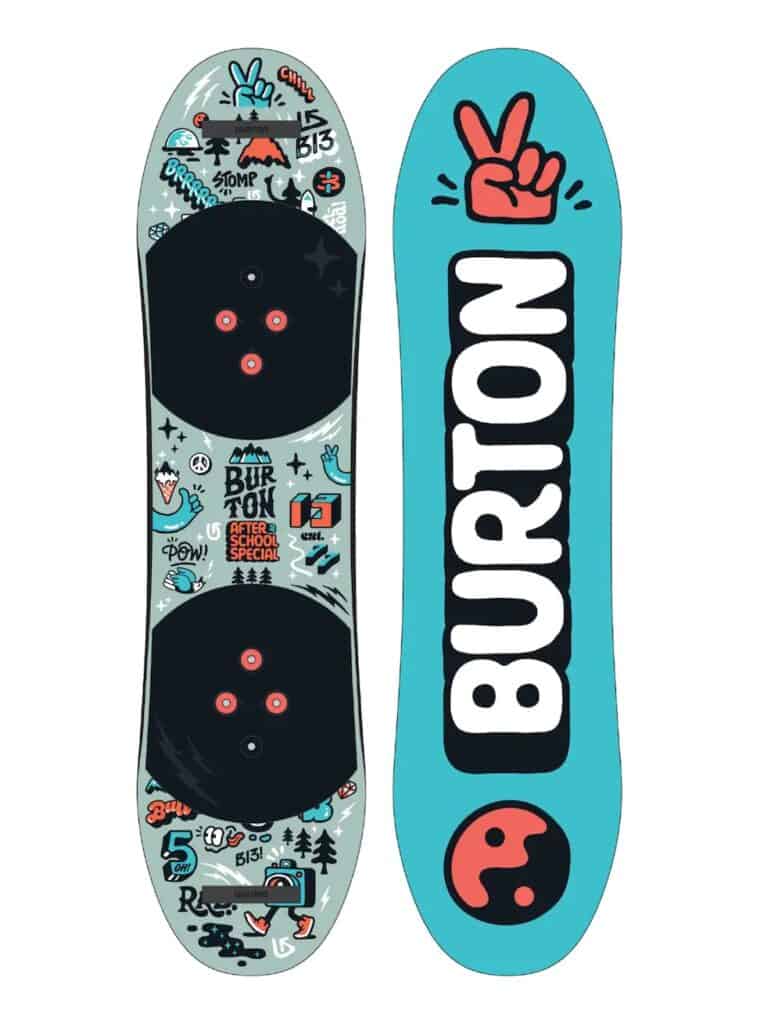
Burton After School Special Snowboard & Binding Package. Kids snowboards. Source: Burton

Key Features

  • Easy Bevel helps reduce edge catches
  • Twin shape allows children to ride regular or switch
  • Removes some of the complication of buying a child’s first setup
Pros
  • Complete snowboard-and-binding package
  • Bindings arrive pre-mounted and adjustable
  • Very soft and forgiving for beginners
Cons
  • A child who progresses quickly may want a more responsive board

If you’re buying your child their first snowboard setup and want to keep things as simple as possible, the Burton After School Special is one of my favourite options. Unlike most of the kids’ snowboards on this list, it comes with bindings already included and pre-mounted, so you don’t have the additional job of finding compatible bindings and setting everything up from scratch.

The board has been designed to make those first days of snowboarding less frustrating. Burton uses its Flat Top profile with Easy Bevel, which creates a stable platform underfoot while the convex base lifts the edges slightly away from the snow. The result is a very soft, forgiving board designed to reduce the chances of catching an edge, which can make a big difference when your child is learning their first turns.

This was the first snowboard we used with our girls and I like the fact that the bindings are fully adjustable and arrive mounted in a beginner-friendly stance. It also has a handy pull rope, so you can gently pull them along on the snow or if you’re at home, practising their balance on the carpet.

The current model is available in 80cm, 90cm, and 100cm sizes.

Best for: First-time and beginner snowboarders
Ability: Beginner
Sizes: 80cm, 90cm, and 100cm
Profile: Flat Top with Easy Bevel
Shape: Twin
Flex: Soft/playful, twin flex
Base: Extruded
Bindings: Included and pre-mounted

2. Nitro Arial Kids’ Snowboard: Best for Progressing Young Riders

Arial Kids' All Mountain Snowboard. Source: Absolute-Snow

Key Features

  • Suitable for progression from groomed runs towards park and freestyle
  • It has a durable, relatively low-maintenance extruded base
  • Made from poplar wood from tip-to-tail to deliver lightweight strength with optimised flex
Pros
  • Soft, forgiving flex for lighter young riders
  • Cam-Out Camber balances responsiveness with forgiveness
  • True twin shape allows children to learn to ride switch
Cons
  • It’s not really aimed at very young or small first-time snowboarders

The Nitro Arial is a great option for young snowboarders who have mastered the basics and are ready to start exploring more of the mountain. Rather than being designed purely as a first-time beginner board, it offers enough performance for children to continue developing their turns, confidence and their freestyle skills.

It uses Nitro’s Cam-Out Camber profile, which combines traditional camber with smoother transitions towards the tip and tail. This gives young riders some of the response and edge control of a cambered board while keeping the ride relatively forgiving. We found this was useful when our eldest was still perfecting turns and catching the occasional edge.

The soft 3/10 flex is another feature I like for younger riders. Children generally don’t have the weight or strength to flex a stiff adult-style snowboard easily. Our eldest found that the Arial wasn’t too hard to manoeuvre and initiate turns on.

It’s also a true twin, with the same shape at the nose and tail and a centred stance. That’s useful as children progress because they can start experimenting with riding switch, side hits and their first park features without needing a dedicated freestyle board.

The 2023 model currently listed by Absolute Snow comes in 138cm, 142cm, and 146cm, with recommended rider weights ranging from under 45kg for the 138cm up to 45โ€“65kg for the 146cm.

Best for: Beginner to intermediate riders ready to progress
Sizes: 138cm, 142cm, and 146cm
Profile: Cam-Out Camber / hybrid
Shape: True twin
Flex: Soft, 3/10
Terrain: All-mountain
Bindings: Not included

3. CAPiTA Jess Kimura Mini 2026: Best for Young Freestyle Riders

CAPiTA Jess Kimura Mini 2026. Source: Blue Tomato

Key Features

  • Soft, forgiving flex for lighter riders
  • True twin shape is well suited to learning switch
  • Rockered and bevelled profile helps create a catch-free feel
Pros
  • Good progression option between a first kids’ snowboard and an adult board
  • Designed for park features, jumps and general resort riding
  • Durable, low-maintenance extruded base
Cons
  • Not the board I’d choose for a very young first-time snowboarder

For young snowboarders who have moved beyond their very first turns and are starting to explore more of the mountain, the CAPiTA Jess Kimura Mini is a fun progression board with a particular focus on freestyle riding.

The board has been designed as the step between CAPiTA’s smaller beginner-focused Micro Mini boards and its full-size women’s range, giving young girls something if they’ve outgrown their first snowboard, but aren’t yet big enough for an adult board.

CAPiTA uses a Park Mini profile, combining reverse camber with a bevelled shape to create a forgiving, catch-free ride. That’s useful for younger riders who are developing their turns, but also starting to experiment with things like small jumps, boxes, bumps, and riding switch.

The true twin shape is another reason I’d consider this for a child interested in freestyle. The board is symmetrical from tip to tail, so it should feel balanced whether they’re riding in their normal direction or switch. It also has a soft 3/10 twin flex, keeping it manageable for lighter riders while still providing enough pop for progression.

The Jess Kimura Mini is available in 115cm, 120cm, 125cm, 130cm, and 135cm, covering recommended rider weights from approximately 23kg up to 39kg, depending on board length. As always, use your child’s weight and boot size alongside the manufacturer’s sizing chart rather than choosing a board purely according to age or height.

Best for: Progressing young riders interested in freestyle
Ability: Progressing beginner/intermediate
Sizes: 115cm, 120cm, 125cm, 130cm, and 135cm
Profile: Park Mini / reverse camber
Shape: True twin
Flex: Soft, 3/10
Terrain: Resort and park
Base: XXX[TRUDED] extruded base
Bindings: Not included

4. Jones Youth Flagship: Best for Advanced Young Riders

Jones Youth Flagship. Junior snowboard. Source: Snowboards.EU

Key Features

  • Excellent option for progressing and experienced young riders
  • Directional shape provides stability and powder float
  • Camber underfoot gives good response and edge control
Pros
  • It’s well suited to freeride and powder
  • Wide size range for growing riders
  • Gives capable children a performance board rather than an overly simplified kids’ model
Cons
  • Directional design isn’t as freestyle-oriented as a true twin

For confident young snowboarders who are ready to explore more challenging terrain, the Jones Youth Flagship is a serious step up from other beginner kids’ snowboards. It’s a youth-focused freeride board, designed for riders who want to carve confidently on piste, venture into powder, and tackle more technical terrain.

Unlike many kids’ snowboards that use a twin shape, the Youth Flagship has a tapered directional shape. The nose is designed to provide more float in soft snow, while the directional setup gives the board the stability and control that progressing riders need when they’re travelling faster or riding steeper terrain.

It also uses a Directional Camber/Rocker profile, with camber between the bindings combined with more rocker towards the nose. This gives young riders useful edge grip and response when carving while helping the nose float more easily in powder. There’s also some rocker towards the tail, helping your young rider make turn initiation less demanding than you’d expect from a traditional full-camber freeride board.

The Youth Flagship is considerably more performance-focused than something like the Burton After School Special. Jones describes the current board as having a medium/lively flex, so I’d recommend it for a child who already has good snowboard control rather than someone learning their first turns.

Sizes range from 127cm to 147cm, with recommended rider weights starting at around 31kg for the 127cm and reaching approximately 68kg for the larger sizes. That makes this a good option for older children and teenagers who aren’t yet suited to a full-size adult Flagship.

Best for: Confident intermediate-to-advanced young riders
Sizes: 127cm, 132cm, 137cm, 142cm, and 147cm
Profile: Directional Camber/Rocker
Shape: Tapered directional
Flex: Medium/lively
Terrain: All-mountain, freeride and powder
Base: Sintered 8000
Bindings: Not included

5. Salomon Team Junior Snowboard: Best Value Kids’ Snowboard

Salomon Team Junior Snowboard. Source: Snowinn

Key Features

  • Much cheaper than several of the other boards in this guide at the current sale price
  • Soft and forgiving for young riders
  • Flat profile helps provide stability
Pros
  • Catch-resistant design aimed at beginners
  • True twin shape allows progression into riding switch
  • Durable, low-maintenance extruded base
Cons
  • Designed primarily for beginners rather than aggressive or advanced riders

If you’re looking for kids’ snowboards without spending several hundred pounds, the Salomon Team Junior is an appealing option. It’s designed for younger riders learning to snowboard, combining a forgiving construction with features intended to make those early turns easier.

The flat profile provides a stable platform underfoot, while the board’s slightly concave base helps reduce unwanted edge catches.

Salomon also uses a true twin shape, meaning the nose and tail are symmetrical. This gives the board a balanced feel in either direction and allows a young rider to start experimenting with riding switch as their confidence improves.

The flex is deliberately soft and forgiving too. With a softer board, your child can make turns and control the board at slower speeds. Salomon uses lightweight biaxial fibreglass to help maintain that playful feel.

Another practical feature is the extruded base. It won’t offer the outright speed of a high-performance sintered base like the one on the Jones Youth Flagship, but that’s not a priority for a beginner. An extruded base is durable and relatively low maintenance, making sense for a children’s board that’s likely to pick up the occasional scratch.

Best for: Budget-conscious families and beginner riders
Ability: Beginner
Sizes: 70cm, 80cm, 90cm, 100cm, and 110cm
Profile: Flat
Shape: True twin
Flex: Soft
Base: Extruded
Terrain: All-mountain / learning
Bindings: Not included

Read more: 10 Best Family Ski Resorts in Austria 2026: The Ultimate Guide

A kid's snowboard leaning against a trunk. Photo by Erik Mclean on Unsplash
Photo byย Erik Mcleanย onย Unsplash

How to Choose the Right Kids’ Snowboard Size

The old advice that the board should reach your child’s chin when stood upright is a good starting point, but modern sizing guidance places just as much emphasis on weight as it does on height. A lighter child riding a longer board will struggle to flex it and initiate turns; a heavier child on a board that is too short will find it unstable at speed.

Kids’ Snowboards Size Chart

Child’s HeightChild’s WeightRecommended Board Length
Under 100cmUnder 20kg<80cm
100cm-110cm15-20kg80cm-95cm
110cm-120cm20-25kg95cm-105cm
120cm-130cm25-30kg105cm-109cm
130cm-140cm30-35kg109cm-125cm
140cm-150cm35-40kg125cm-135cm
150cm-160cm40-50kg135cm-150cm

This kids snowboards sizing chart is a guide only. Always cross-reference with the manufacturer’s sizing chart for the specific board you’re buying.

Weight vs Height: Which Matters More?

Both matter, but if they give conflicting results, I would lean towards weight for beginner riders. A soft-flex junior snowboard needs to bend to initiate turns. If the board is too long for a light child, they can’t flex it enough to get it working how they want. On the other hand, if your child is on the heavier end for their height, a longer board adds stability at speed.

Adjusting for Ability Level

Once you have a size range from the chart above, ability level should guide where within that range you choose:

  • Beginner rider: choose the shorter end of the range. A shorter board is lighter, easier to turn, and more forgiving.
  • Intermediate rider: choose the middle of the range. They have the strength and technique to handle a slightly longer snowboard, which will give them more stability and room to progress.
  • Can you buy a board for a child to grow into? Slightly, yes, but you don’t want to buy one that’s too big. Going one size up is acceptable if you want to extend the life of the board, particularly if your child is between sizes and growing quickly. Going two sizes up is too much and will make learning harder. Several brands, including Burton, design their bindings with adjustable mounting positions to accommodate a couple of seasons of growth.

Rocker vs Camber for Kids: What Does It Mean?

Board profile describes the shape of kids’ snowboards when it’s laid flat on a surface. It matters because it changes how the board rides.

Rocker (Reverse Camber)

A rocker profile curves upward at both ends, creating a gentle banana shape. On the snow, this means the tips and tail lift slightly off the surface. The result is a board that’s very forgiving, makes turn initiation easier, and is less likely to catch an edge.

For a beginner rider, these are all excellent qualities. Rocker profiles also tend to handle softer snow and light powder well, as the raised tips float more naturally rather than digging in.

Camber

A camber profile arches upward slightly in the middle, meaning the board contacts the snow at the tips and tail, but lifts slightly in the centre. This gives more edge grip, better pop for jumps, and a more responsive feel. It’s generally a profile for more experienced riders who want feedback and precision from their board. A pure camber profile is more likely to catch an edge if your child’s technique is not yet consistent.

Flat

A flat profile sits almost entirely flush with the snow. It’s a stable, predictable middle ground that’s more forgiving than camber, but with more edge contact than a full rocker.

Hybrid Camber

Most modern junior snowboards use some variation of a hybrid profile, blending rocker sections (usually at the tips) with camber underfoot. The goal is to combine the forgiving, easy-turning nature of rocker with the stability and edge grip of camber.

My recommendation for beginners: flat or rocker/hybrid. For progressing intermediates: hybrid camber or a mild camber board.

Read more: Teaching Toddlers to Ski: 30 Proven Tips You Need That Work

A young child snowboarding on snow. Source: Canva
Source: Canva

What Snowboard Flex is Best for Kids?

The flex on kids’ snowboards refers to how stiff or soft a snowboard is. It’s usually rated on a scale of 1 (very soft) to 10 (very stiff), though most brands use descriptive terms such as soft, medium-soft, medium, and stiff.

For most children, a soft flex is the right starting point:

  • A softer board is easier to bend, meaning a lighter young rider can flex the board through turns rather than just skidding around
  • Soft flex makes the board more forgiving of imperfect technique, which is exactly what a beginner needs
  • It encourages board control and natural body movements rather than forcing a child to muscle the board

When to Consider a Stiffer Flex

As your child progresses to intermediate level, riding faster, starting to carve, perhaps experimenting with small jumps, a medium-soft or medium flex will give them more response from the board. Stiff flex boards are firmly in adult territory and aren’t appropriate for most children.

If you’re ever in doubt, go softer. A child cannot get the best out of a board that is too stiff for them. A slightly softer board than ideal will still ride well.

Should You Buy or Rent Kids’ Snowboards?

This all depends on how much snowboarding your family does.

The Case for Renting

  • Children grow quickly and a board that fits perfectly this winter may be too small by Christmas
  • Rental equipment is generally well-maintained and appropriate for ability level
  • You’re not committing hundreds of pounds to something your child might decide they don’t enjoy
  • Boots are worth renting for small children, whose feet can change by a full size in a season
  • If you only ski or snowboard once a year, rental almost always makes more financial sense
  • If your child is taking snowboard lessons, rental equipment is usually included in the lesson package

The Case for Buying

  • If your family goes on two or more snow holidays a year, or regularly visits dry slopes or snowdomes in the UK, owning equipment adds up quickly
  • Familiarity matters. My girls ride better on their own kids’ snowboards because they know exactly how they feel
  • Buying secondhand or preloved is a realistic option for children’s snowboards, as good-quality junior boards hold up well and are widely available on sites like eBay, Facebook Marketplace, and specialist ski and snowboard resale groups
  • A board like the Burton After School Special with adjustable bindings can last a child two to three seasons before they outgrow it

Read more: 11 of the Best Kidsโ€™ Ski and Snowboard Jackets for 2026

Do Kids’ Snowboards Come with Bindings?

Some do, some do not. The Burton After School Special is one of the few junior packages that includes both the board and bindings. Most other junior snowboards are sold as board-only, so you’ll need to buy compatible bindings separately.

If you’re buying your child’s first snowboard, I strongly recommend a complete package like the Burton After School Special for simplicity. If you’re upgrading an existing setup, buying the board and bindings separately gives you more flexibility.

FAQs on Kids’ Snowboards

1. What size snowboard does my child need?

Use the size chart above as a starting point, balancing your child’s height and weight. For beginner riders, go toward the shorter end of the range. Always cross-reference with the manufacturer’s own sizing chart for the specific board.

2. What is the best snowboard for a beginner child?

The Burton After School Special is my top pick for complete beginners, thanks to its forgiving flat profile, soft flex, and included bindings.

3. Should my kids use rocker or camber snowboards?

For beginners, a flat or rocker/hybrid profile is best; it’s more forgiving and makes learning to turn much easier. Camber and hybrid camber profiles become more appropriate as a child’s ability and technique develop.

4. What snowboard flex is best for kids?

Soft flex for beginners and most younger riders. Medium-soft flex for confident intermediates. Stiff flex is generally not appropriate for children.

5. How long will a child’s snowboard last?

A good-quality junior snowboard can last two to four seasons depending on how much it is used and how quickly your child grows.

6. Can you buy any kids’ snowboards for a child to grow into?

Slightly, yes. Going one size larger than the recommended size is acceptable, particularly if adjustable bindings allow for repositioning as they grow. Going more than one size too large will make the board harder to turn and will slow their progress.

7. How do I know if my child is regular or goofy?

Regular stance means your child rides with their left foot forward; goofy means right foot forward. A quick way to test it at home: stand behind your child and give them a very gentle push. Whichever foot they instinctively step forward with to catch themselves is likely their lead foot.

8. What protective gear does my child need for snowboarding?

A well-fitted helmet is non-negotiable, see my guide to the best ski and snowboard helmets for kids for recommendations. Wrist guards are also worth considering for beginners. Impact shorts with built-in padding are another option for younger or more nervous riders.

Read more: The 6 Best Budget Family Ski Resorts in France in 2026

Final Thoughts on Kids’ Snowboards

After several winters on the slopes with my own two, here is where I land on kids’ snowboards:

  • Best complete beginner setup: Burton After School Special. The snowboard and bindings come as a complete package, while the soft flex and forgiving Flat Top profile make it a great choice for a child’s first snowboard.
  • Best for progression: Nitro Arial. A great next step for young riders who have mastered the basics and want a snowboard that can help them progress across the mountain.
  • Best for freestyle: CAPiTA Jess Kimura Mini. The soft flex, true twin shape and forgiving profile make this my pick for young riders who want to start exploring freestyle, riding switch and the park.
  • Best for advanced and freeride riders: Jones Youth Flagship. A more performance-focused option for confident young snowboarders who are ready for faster riding, carving, powder and more challenging terrain.
  • Best value: Salomon Team Junior. A forgiving beginner board from an established snowboard brand that offers particularly good value if you can find it at the lower prices currently available.

Whatever choice you make from the list of kids’ snowboards, getting the sizing right matters. Your child’s weight, height, boot size, and ability should all influence your decision.

A correctly sized junior snowboard with an appropriate flex will be easier to turn and control, and that can make a much bigger difference to how much your child enjoys learning to snowboard.

For more snow inspiration, check out our related guides:

Happy snowboarding!


Have you found this kids’ snowboards guide useful? What junior snowboard has caught your child’s eye? Have they been snowboarding before? If so, what did they enjoy about it? If not, are they excited to try? Share your thoughts in the comments below!

Similar Posts

Leave a Reply

Your email address will not be published. Required fields are marked *